

Background
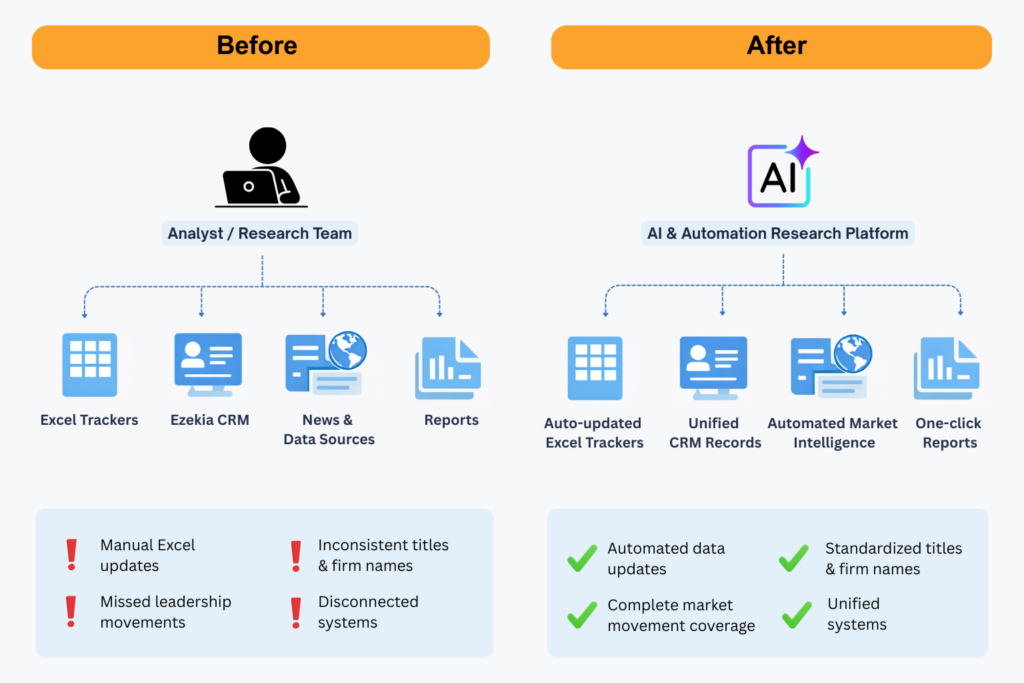
A global executive research firm specializing in financial services and investment banking relied heavily on analyst-driven market intelligence. Their core value proposition depended on accurately tracking leadership movements, mapping industry talent, and producing high-quality client reports. However, manual data entry, fragmented systems, and time-intensive reporting workflows were limiting scale, speed, and consistency.
What They Do
The firm conducts ongoing executive research and market intelligence for the financial services and investment banking sector. Their work involves:
• Tracking leadership changes, role movements, and talent shifts across firms
• Maintaining structured talent maps and movement records for analysis
• Managing candidate profiles and research data across internal systems
• Producing customized client reports in multiple formats
• Validating research data for accuracy, consistency, and compliance
• Supporting region-specific research workflows across the U.S. and Europe
This work spans continuous market monitoring, data management, and client reporting across multiple teams and regions.
Challenges
| Challenge | Description |
|---|---|
| Manual Data Entry | Analysts updated Excel and CRM separately, causing duplicate work. |
| Inconsistent Data Accuracy | Firm names, titles, and sectors varied across sources, reducing reliability. |
| Limited Market Coverage | Manual monitoring caused roughly 25% of movements to be missed. |
| Slow, Manual Reporting | Reports required hours of formatting, firm exclusions, and template adjustments. |
| Disconnected Systems | Analyst notes, Excel trackers, and CRM data were not synchronized. |
| Regional Inconsistencies | U.S. and European teams used different templates with GDPR considerations. |
| Scalability Bottleneck | Heavy reliance on manual validation slowed research cycles. |
Our Approach
Agenthum Solutions designed a phased AI & automation roadmap to modernize the entire research lifecycle while preserving the familiarity of Excel-based workflows.
Key actions included:
- Automated market intelligence gathering via a hybrid RPA + API strategy
- Standardization engine for titles, firms, sectors, and movements
- Auto-update workflows for Mapping & Movers Excel trackers
- A centralized Data Hub to eliminate system silos
- Bi-directional Ezekia integration for unified candidate records
- A web-based report builder to generate Word, PPT, and PDF client decks
- Optional AI enrichment for executive summaries and data validation
This approach blended quick wins with long-term automation scalability.
Solution Architecture
The implemented solution spanned three major automation layers:
1. Market Intelligence Automation
- RPA bots collected data from LinkedIn Recruiter, Bloomberg Terminal, and FINRA BrokerCheck
- API integrations pulled updates from eFinancialCareers, WSJ, Business Insider, and others
- A processing pipeline standardized entries and generated a daily movers report
- Excel trackers were automatically populated and alerts were sent to analysts
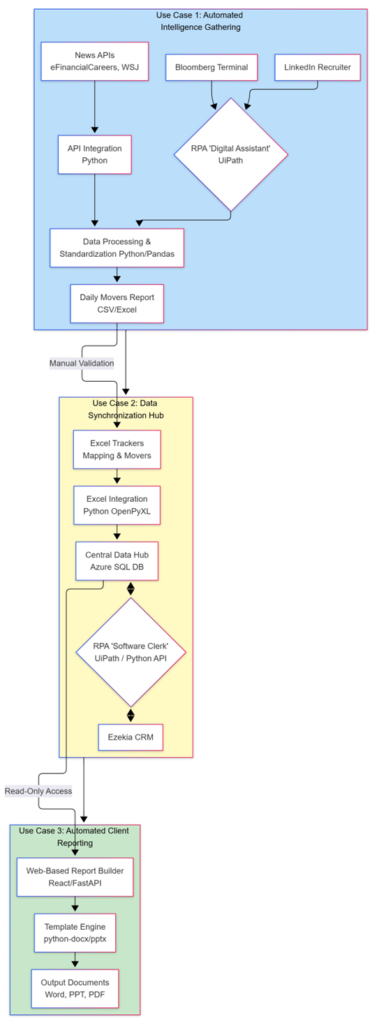
2. Data Entry & Synchronization Automation
- Automated write-back to Mapping and Movers Excel files
- Fuzzy matching + deduplication logic
- A Central Data Hub stored normalized candidate profiles
- Bi-directional Ezekia sync with API as primary method and RPA fallback
- MFA handling for secure access
3. Client Report Automation
- A web-based UI allowed template selection, filtering, and exclusions
- Real-time connection to the Data Hub
- Simultaneous export to Word, PowerPoint, and PDF
- Optional AI-generated executive summaries via Azure OpenAI
Tools & Technologies Used
| Category | Technologies Used |
|---|---|
| Automation & Integration |
|
| Data & Infrastructure |
|
| Application Development |
|
| External Data Sources |
|
Key Results & Business Impact
Quantitative Outcomes
| Metric | Before | After |
|---|---|---|
| Manual Workload | Very high | 70–80% reduction |
| Data Accuracy | Inconsistent | 90–95% accuracy |
| Report Turnaround | Several hours | 78–80% faster |
| Market Movement Coverage | Missed ~25% | Near-complete detection |
Strategic Impact
- Analysts refocused on deeper research instead of manual updates
- Region-specific templates improved brand consistency across US/EU
- GDPR compliance strengthened with automated data handling
- Centralized hub enabled scalable AI/automation expansion
Conclusion
The AI and automation roadmap transformed the firm’s research operations by eliminating manual bottlenecks, improving data accuracy, and accelerating client report delivery. With automated data ingestion, a unified Data Hub, bi-directional Ezekia sync, and a dynamic report builder, the firm now operates with significantly improved efficiency and scalability. This solution laid a strong foundation for future AI-driven insights and advanced analytics across the organization.