

Generative AI in Enterprise Workflows
Enterprise sales and technical bidding teams operate under constant pressure to respond faster while handling growing volumes of complex Requests for Proposals (RFPs). As global markets scale and client expectations rise, maintaining consistent, high-quality, and highly precise technical proposals becomes increasingly difficult.
A significant portion of RFP drafting is not a creative hurdle; it is a repetitive, data-intensive, and time-consuming process of gathering historical metrics, capabilities, and past architectures. Generative AI enables proposal teams to handle these routine documentation interactions efficiently, allowing senior solution architects to focus on strategic engineering, pricing accuracy, and high-value client engagement.
In this blog, we share how a secure, Generative AI–powered RFP framework helps organizations drastically accelerate response times and automate up to 70 percent of routine proposal generation without compromising quality or brand consistency.
Why Traditional RFP Creation Models Are No Longer Enough
Many enterprise business development teams still rely heavily on manual tracking supported by scattered internal case studies, static text documents, or legacy search repositories. While these approaches have functioned historically, they utterly fail to scale when concurrent client deadlines hit.
The result is common across industries:
- Extremely slow turnaround times that risk missing strict client submission deadlines.
- Technical leads spending highly valuable billable hours rewriting repetitive technical stack methodologies from scratch.
- Inconsistent brand messaging and misaligned commercial estimations across regional teams.
- Severe strategic dependency risks, highlighted by recent global events like the June 12, 2026 US export restrictions that suddenly revoked access to proprietary models like Claude 5 for foreign entities.
- Rising proposal overhead costs without a proportional increase in bid win rates.
Enterprise leaders often ask us: “Can we automate the heavy lifting of gathering capabilities and drafting proposals without sacrificing legal and technical precision?”
A sovereign architecture combining Retrieval-Augmented Generation (RAG) with secure, open-source Large Language Models (LLMs) makes this entirely possible.
Use Case: Automating Enterprise RFP Generation Using Sovereign AI
The Challenge Bid Teams Face
Across the IT and software services industries, client RFPs present dense, complex requirements documents in PDF formats. Matching those multi-layered demands to precise internal talent skills, historical cost baselines, and pre-approved reference architectures remains a massive manual bottleneck. Furthermore, uploading confidential enterprise capabilities or project details into public, third-party cloud APIs presents unacceptable data privacy and continuity risks.
When organizations approached us, they were struggling with:
- High volume of incoming client RFPs with short deadlines.
- Core solution architects spending valuable time on low-value data retrieval.
- A complete lack of centralization for historical costing metrics and skills matrices.
- Vulnerability to sudden cloud API outages or sudden geopolitical software revocations.
- Difficulty maintaining strict formatting and structural consistency across final client deliverables.
The Agenthum AI Approach
At Agenthum AI Solutions, we build secure, intelligent, and semi-automated Generative AI frameworks that ground your response pipeline in your actual enterprise capabilities using a RAG-first framework.
To give you a clear visual understanding of how this end-to-end framework operates seamlessly from client ingestion to final asset creation, here is our comprehensive solution blueprint:
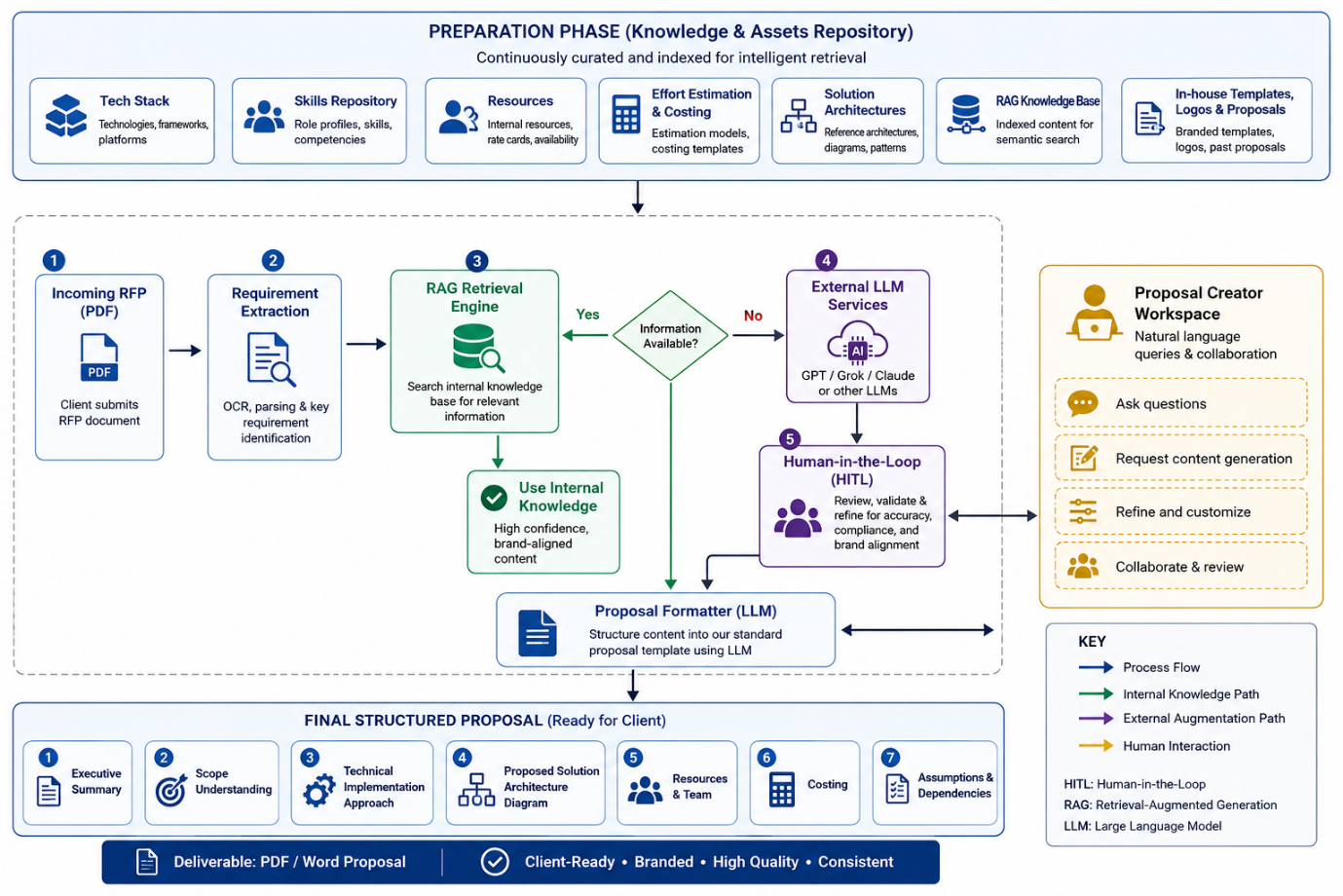
Diagram Breakdown: The architecture operates in a secure, six-step pipeline. It begins with the Preparation Phase (1), indexing your corporate assets into a secure Knowledge Base. Upon RFP Intake (2), the system extracts core requirements and routes them through a RAG Retrieval Engine (3). If supplementary context is needed, queries are securely passed to an External Sovereign LLM (4). A mandatory Human-in-the-Loop checkpoint (5) ensures absolute accuracy before the Proposal Formatter (6) generates the final, structured PDF deliverable.
Our intelligent system dynamically parses decision signals across multiple enterprise layers, running verification protocols sequentially:
| Decision Signal Category | What We Analyze |
|---|---|
| RFP Requirement Extraction |
|
| Knowledge Base & RAG Grounding |
|
| Conversational Interactive Workspace |
|
| Sovereign Model Routing & Safety |
|
| Human-in-the-Loop (HITL) Checkpoints |
|
| Continuous Learning Loops |
|
For example, when an RFP demands a detailed architectural plan for an enterprise conversational AI system, our framework automatically parses the document, matches it with pre-approved technical specifications, pulls secure internal effort estimates, and formats an initial complete draft instantly. If a complex compliance clause or highly localized pricing dynamic is encountered, the system seamlessly highlights the section and flags it for your senior legal or financial leads to adjust.
Real Results from Our Enterprise RFP Clients
Organizations implementing our secure RAG-powered proposal systems have achieved:
- Up to 50% to 70% reduction in end-to-end proposal creation time.
- Accelerated turnaround speeds, allowing teams to comfortably respond to a higher volume of concurrent bids.
- Drastically reduced non-billable workload pressures for core solution architects.
- Complete elimination of formatting discrepancies across critical, high-stakes client deliverables.
- 100% operational uptime and zero dependency on restrictive proprietary cloud APIs.
Instead of drowning technical experts in highly repetitive administrative copying and pasting, business development teams can focus entirely on perfecting commercial pricing strategies and delivering deep technical value.
From Automation to Better Customer Experience
Automated RFP generation enhances the overarching B2B client experience by producing meticulously detailed, brand-aligned proposals in a fraction of historical response windows.
Business development teams can:
- Deliver rapid, professionally structured proposals days ahead of competitors.
- Ensure all technical answers are completely grounded in verified historical execution data.
- Eliminate client friction stemming from missing structural elements or miscalculated baseline estimates.
- Free up technical talent to spend meaningful collaborative hours with prospects refining project scopes.
The Technology We Use
We deploy secure, enterprise-ready Generative AI infrastructure designed for complete strategic autonomy and reliability:
| Technology Layer | Why It Matters | Models & Tools Used |
|---|---|---|
| Large Language Models (LLMs) | Provide advanced logical reasoning and high-tier semantic synthesis to draft precise executive summaries and technical outlines. |
|
| Knowledge Grounding Layer | Enforces zero-hallucination guardrails, ensuring text generation stays perfectly restricted to factual company capabilities and past project data. |
|
| Proposal Creator Workspace | Provides teams with natural language editing controls, interactive prompt toolkits, and concurrent drafting workspaces. |
|
| Confidence & Safety Controls | Flags any unverified information, validates complex commercial figures, and confirms strict compliance alignment. |
|
| Human Handoff & Formatting Layer | Translates verified textual architectures smoothly into structured, client-ready, and highly polished corporate documents. |
|
| Secure Sovereign Infrastructure | Guarantees total data privacy, isolated network containerization, and strict compliance with local regulatory guidelines. |
|
Unlike standard, public consumer-grade web apps, our enterprise system is structurally hardcoded to only retrieve information from your approved organizational history. Answers are constructed through rigorous data matching with built-in human verification locks, giving you accelerated asset production while maintaining absolute factual certainty and security.
Value Beyond Cost Reduction
Organizations realize strategic benefits far beyond simple operational speed gains:
- Total immunity against international software-level export control directives or sudden commercial API outages.
- Centralization of valuable, scattered institutional memory into a secure corporate brain.
- Significantly smoother onboarding loops for newly hired technical pre-sales engineers.
- Scalable proposal output bandwidth without requiring a proportional increase in headcount overhead.
- Enhanced trust signals in market positions by pitching as a modern, AI-first technological organization.
How We Support Implementation
We understand that enterprise IT landscapes and historical document indices are highly complex. Here’s how we guide your deployment:
Knowledge Integration
We seamlessly map and index your scattered file servers, past winning proposals, commercial guidelines, and internal capability frameworks into a secure matrix.
Safety and Accuracy
We configure strict multi-layered RAG verification guardrails ensuring output generation stays 100% bound to verified historical assets.
Workflow Fit
Our automation engines hook cleanly into your existing internal CRM platforms, collaborative team spaces, and document repositories.
Human-in-the-Loop
We customize explicit validation dashboards, ensuring your senior solution architects remain the definitive gatekeepers for every commercial estimate.
Continuous Improvement
We integrate localized feedback loops that allow models to become incrementally sharper as your technical capabilities and service catalog expand.
What We’re Building for the Future of Enterprise AI
We continue to push the boundaries of localized corporate intelligence frameworks with:
- Deep optimizations for localized, sovereign hardware container nodes.
- Multilingual RFP translation and response synthesis engines for global public tenders.
- Automated generation of interactive, web-based digital client proof-of-concepts directly from requirements.
- Predictive commercial win-probability modeling integrated into initial intake parsing steps.
- Unified knowledge mapping linking sales architectures directly to active software development repositories.
Ready to Secure Your Sales Pipeline with Generative AI?
Enterprise business development thrives when repetitive data harvesting is completely automated, allowing technical masterminds to dedicate their focus to true engineering innovation. Generative AI delivers that exact equilibrium.
At Agenthum AI Solutions, we help organizations:
- Automate 50% to 70% of the heavy lifting behind enterprise proposal creation.
- Protect high-stakes sales operations from sudden international cloud supply chain shocks.
- Support pre-sales engineering squads with highly precise, secure, and brand-aligned AI co-pilots.
Let’s talk about how secure, sovereign Generative AI can future-proof your proposal operations and unlock hidden scale in your business pipeline.
Contact Agenthum AI Solutions
📞 +91 955 582 1832
🌐 www.agenthumsolutions.com
Agenthum AI Solutions
Helping enterprise teams scale